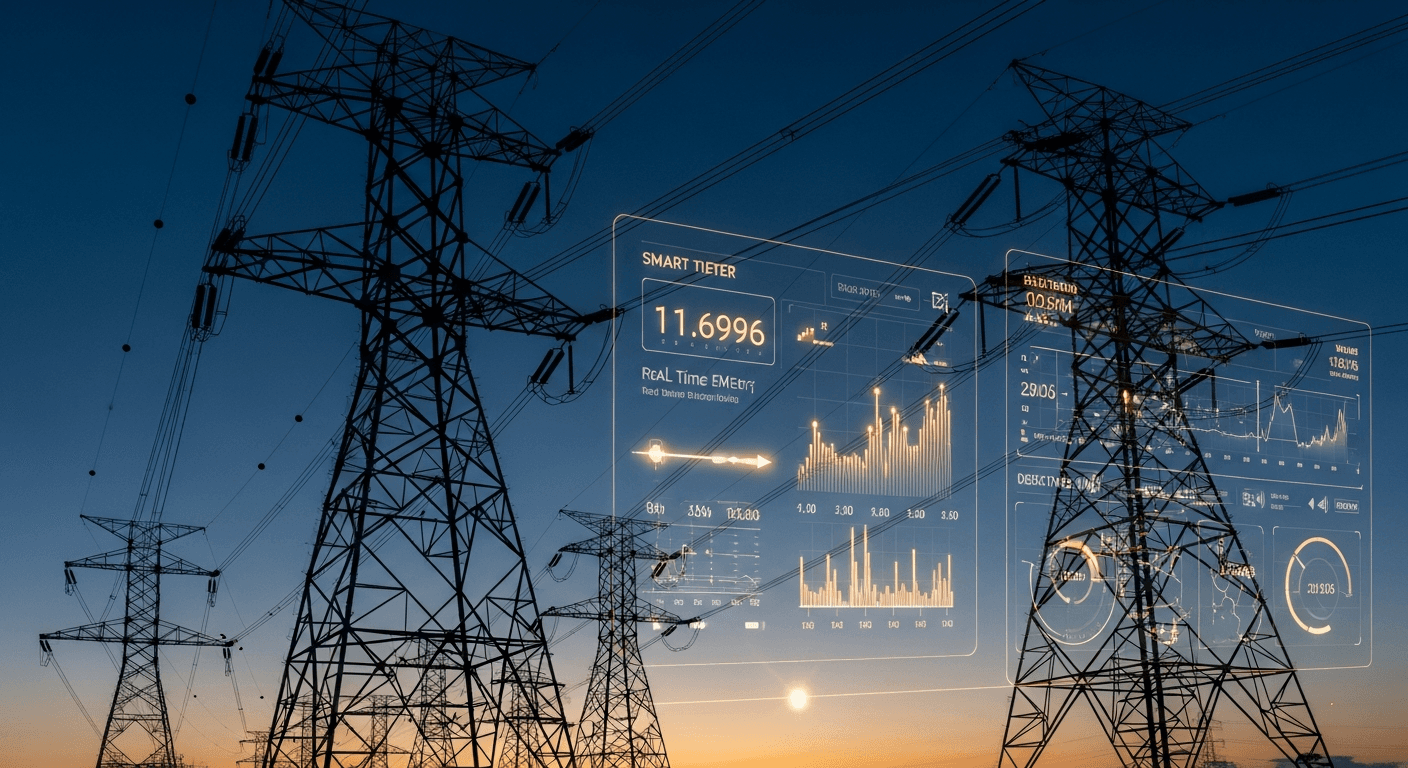
India loses approximately Rs 90,000 crore annually to Aggregate Technical & Commercial (AT&C) losses in power distribution. A significant portion of these losses stem from inaccurate metering, billing errors, and energy theft. Smart metering — or Advanced Metering Infrastructure (AMI) — is the government's primary weapon against this problem.
The National Smart Grid Mission has mandated the deployment of 250 million smart meters across India by 2025-2027. This is one of the largest smart metering rollouts in the world, driven by central government funding and implemented through state distribution companies (DISCOMs) and their private partners.
Smart meters communicate consumption data in near real-time via RF mesh, GPRS, or NB-IoT networks to a central Head-End System (HES). This eliminates the need for manual meter reading, reduces billing disputes, and enables time-of-use (ToU) tariffs that incentivize off-peak consumption.
For DISCOMs, the benefits extend far beyond accurate billing. Smart meters enable remote connect/disconnect operations, tamper detection alerts, power quality monitoring, and outage detection. Distribution transformers equipped with smart meters can report overloading and phase imbalance conditions automatically.
The IS 16444 standard governs smart meter specifications in India, covering accuracy classes, communication protocols, and tamper-resistant features. Meters must support DLMS/COSEM communication standards and integrate with the MDMS (Meter Data Management System) that processes the massive data volumes generated.
UDS Infrastructure's electrical division is actively involved in smart metering rollouts, handling the physical installation, commissioning, and integration of AMI systems. Our teams are certified for both single-phase and three-phase meter installations, transformer-mounted metering, and HES connectivity validation across multiple communication technologies.